In this article:
A house fire is traumatic. It eats away your sense of security and, to an extent, your identity. After all, your home was host to beautiful memories. Once the fire is extinguished, potential hazards arise, and air duct cleaning after a fire is critical in order to avoid serious health issues later.
Air duct cleaning after a fire is just one of the many air quality services we offer. As we have demonstrated through the decades, First Call is always the right call when it comes to keeping your home safe and clean.
Although your home may look safe, fire often creates “invisible” problems that can hurt your lungs. That’s why you need a team with expertise and experience to help you through the next step to relieve stress and provide the seamless quality you deserve. Need an estimate? Just contact us. No hassle. No pressure.
In this article, we’ll examine the potential hazards created by a fire’s aftermath. We’ll also take a look at how our restoration company can help you get back to your normal routine as soon as possible.
What Happens to Air Ducts During a Fire?
Air ducts can act as combustion fuel because they are often filled with household dust or lint. Heat, smoke and byproducts are swept into the HVAC system if it is running. If it’s off, then the heat and byproducts can get in through drafts.
This means it’s much easier for soot to contaminate the walls and coils of the duct. Even the mere presence of soot in the HVAC system means that small particles can spread throughout your home. This can cause extensive respiratory problems. If someone in your house has a compromised immune system or any pre-existing health issues, then it is even more critical to get your air ducts cleaned after a fire occurs.
Is Air Duct Cleaning Always Necessary After a Fire?
If the fire was very small and contained (like a kitchen fire that was quickly extinguished), then a thorough air duct cleaning may not be necessary. However, only a visual inspection can provide a reliable answer.
During a visual inspection, we’ll look for:
- Clogged ducts
- Visual contamination
- Particles being released into the home from supply registers
A larger fire, where an entire room or the whole house was engulfed in smoke, always warrants a post-fire air duct cleaning.
It’s often hard to make a judgement call yourself, especially since you’ve undergone the stress of a house fire, regardless of its size.
Let us take the stress off your plate.
Remember, this is not the time for DIY inspections. Only a fire restoration expert near you, like our team at First Call, can accurately identify any contamination, especially since some parts of your HVAC aren’t visible without taking it apart.
What Are the Potential Health Hazards of Soot in Air Ducts?
Before we can really delve into the health hazards of soot, let’s first take a closer look at what soot is.
Soot is a byproduct of incomplete burning of materials containing carbon. This includes everything from wood to household trash. It’s a fine black powder that is full of tiny particles. These particles are so small that even coughing can’t keep them from settling into the lungs. They can even pass into the bloodstream.
When soot is in your air ducts, you may be unaware that the air is spreading these tiny particles throughout your house…and into the air you breathe.
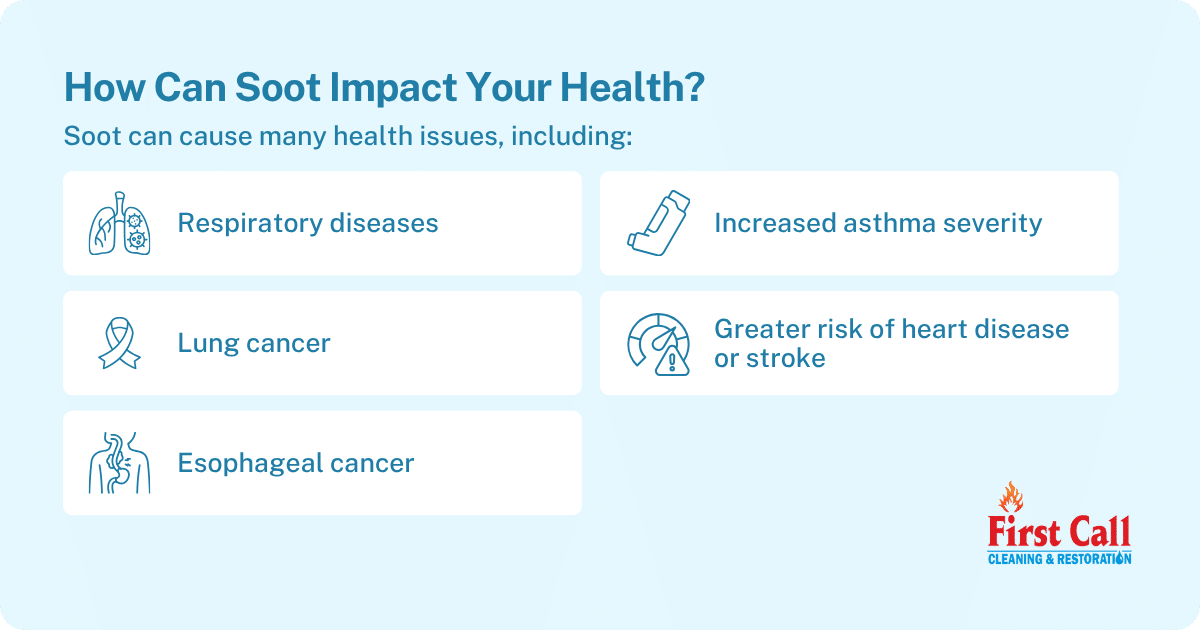
Soot can cause many health issues, including:
- Respiratory diseases
- Lung cancer
- Esophageal cancer
- Increased asthma severity
- Greater risk of heart attacks or stroke
How Are Air Ducts Cleaned After a Fire?
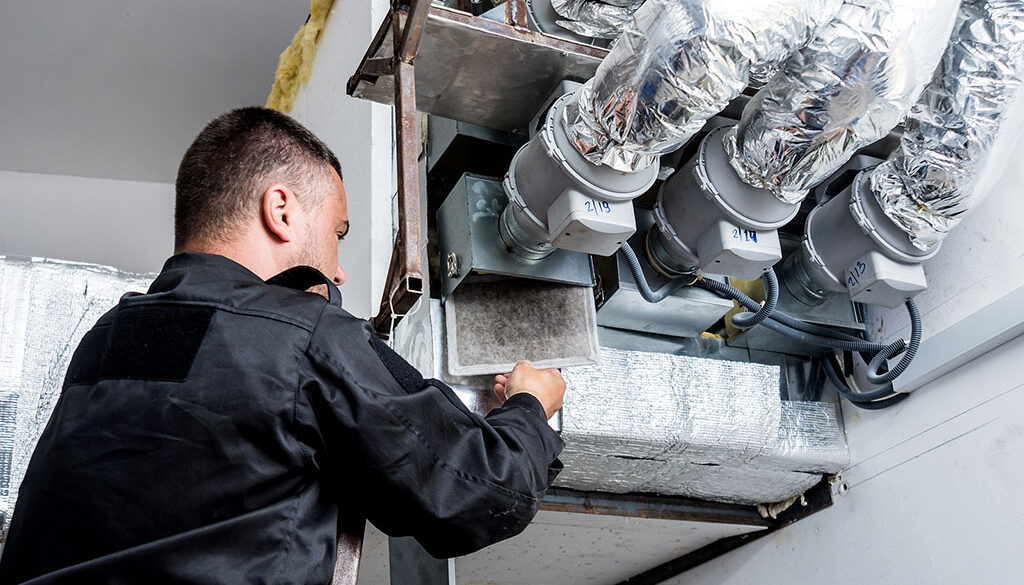
It’s impossible to conduct a thorough air duct cleaning after a fire until we first conduct a detailed inspection to assess the damage. This goes beyond visible ductwork to include items like coils and drain pans, many of which may not be visible. These “hidden” things are often overlooked.
After a detailed inspection, we:
- Set up a negative air pressure system. This helps ensure that no soot is inadvertently spread to other parts of your home. We’re also careful to be sure any exhaust from vacuums is routed outside the house to avoid contamination.
- Dislodge debris using specialized tools. We often combine this with a high-powered, HEPA-filtered vacuum.
- If appropriate, we may use encapsulant sealants after the cleaning is done.
- After cleaning, we conduct another visual inspection.
For extensive damage, like warped metal or melted plastic parts, the HVAC unit may need to be fully replaced. That said, we’re usually able to handle most post-fire air duct cleaning jobs without the need for replacing the entire system.
Does Insurance Cover Fire-Damaged Air Duct Cleaning?
We can’t give one blanket answer. All insurance policies are different. However, most typical homeowners’ policies do offer some type of coverage for air duct cleaning and remediation after a fire.
We will work closely with you to help document the damage and every stage of the cleanup so you can have information readily available to give to your insurance company. We’ll help take the headache out of the process for you. After all, you’ve been through enough.
Make the Right Call: Contact First Call for Air Duct Cleaning After a Fire
Since 1989, First Call Cleaning and Restoration has been the trusted name in cleaning and restoration throughout Greensboro, Burlington and the Triangle area.
As a family-owned company, we bring honesty, transparency, and genuine care to every job we do because we truly care about our communities. We pledge to give you a no-hassle quote and give your home the respect it deserves. We don’t take shortcuts, and we don’t stop until the job is done right.
Don’t let lingering soot put your health at risk. Contact First Call today.
Key Takeaways
- Fires can contaminate air ducts with soot and debris even if the HVAC system wasn’t running during the blaze.
- Only a professional visual inspection, not DIY judgment, can determine whether post-fire duct cleaning is actually necessary.
- Soot particles are small enough to enter the bloodstream and are linked to serious health risks, including respiratory disease and cancer.
- First Call’s cleaning process includes a detailed inspection, negative air pressure setup, debris removal with HEPA-filtered vacuums, and a final inspection.
- Most homeowners’ insurance policies offer some coverage for fire-related duct cleaning, and First Call helps document damage for claims.
=====
Sources:
American Lung Association, “What Is Particle Pollution?” https://www.lung.org/clean-air/outdoors/what-makes-air-unhealthy/particle-pollution#health-effects
Environmental Protection Agency, “Should You Have the Air Ducts in Your Home Cleaned?” https://www.epa.gov/indoor-air-quality-iaq/should-you-have-air-ducts-your-home-cleaned#deciding
National Cancer Institute, “Soot,” https://www.cancer.gov/about-cancer/causes-prevention/risk/substances/soot
Niranjan R, Thakur AK. The Toxicological Mechanisms of Environmental Soot (Black Carbon) and Carbon Black: Focus on Oxidative Stress and Inflammatory Pathways. Front Immunol. 2017 Jun 30;8:763. https://pmc.ncbi.nlm.nih.gov/articles/PMC5492873/